



Why your boiler is leaking water in Missouri

Step 1 of 3: Equipment

Why is my boiler leaking water?

A boiler dripping or pooling water usually means something has failed, not that it needs a quick wipe-down. You want to know where the water is coming from before it causes more damage to the unit or the floor around it. Some causes are minor fittings issues, others point to a bigger problem inside the boiler, and telling them apart matters before you decide what to do next.

Usually a failed valve, loose fitting, or crack in the tank

Most leaks trace back to the pressure relief valve, a corroded fitting, or a crack in the tank itself. The pressure relief valve opens when pressure inside the boiler climbs too high, and if it's dripping, that's often a sign the pressure or the valve itself needs attention. Loose unions and fittings work themselves open over years of heating and cooling, and a slow drip there is usually easy to trace once someone opens the cabinet. A cracked heat exchanger or tank is the serious version, since the part can't be patched and the boiler needs replacing. With gas heat common in homes across Missouri, a leaking boiler in the middle of a cold stretch isn't something to leave alone, since a dropping water level can shut the system down.

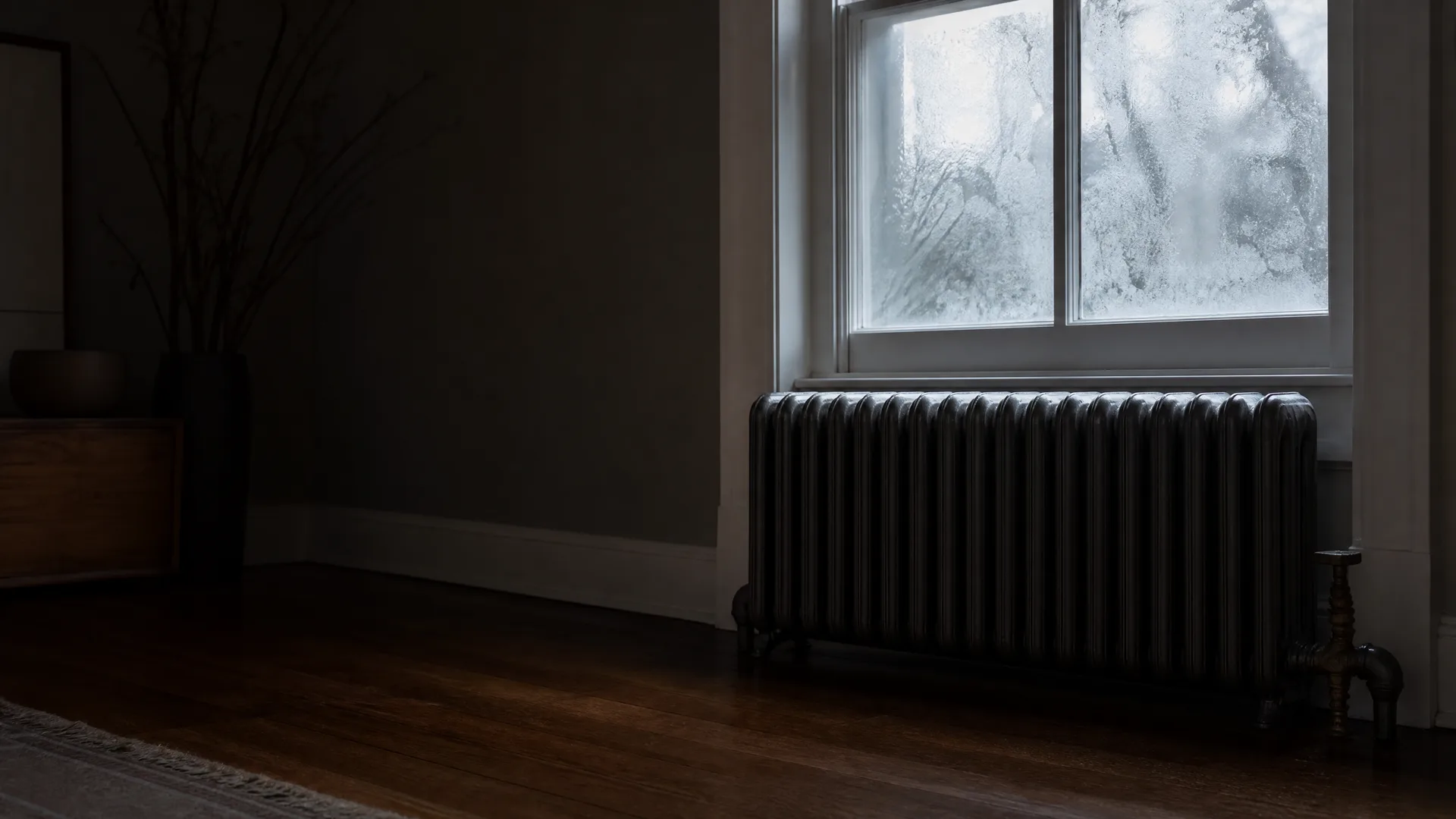
A cast-iron column radiator stands beneath a frosted window in a dim room with dark walls, a wood floor, and a vase of bare branches on a low cabinet at left.

You come downstairs before the sun's up, because the house feels too cold for January. The radiator under the window is cold at the bottom, and there's ice built up on the inside of the glass above it. Then you see the water, a dark ring spreading out from under the boiler across the floor. You put a hand near the pipe going into it and it's barely warm. Outside the window the yard is frozen solid, and you know calling someone today isn't optional. You grab a towel to catch the drip and stand there a minute, listening for the hum that isn't coming.

Is It a Part, or the Boiler Itself

Leak from a part

  • A pressure relief valve that drips usually means the system pressure is too high, and the valve itself may just need replacing.
  • A leak at a pipe fitting or union is often the joint itself failing, and a licensed contractor can reseal or replace just that section.
  • Corrosion at the circulator pump seal shows up as a small puddle right at the pump, and the pump can usually be swapped without touching the rest of the boiler.
  • A cracked or loose drain valve near the bottom of the tank is a common source, and it's a contained fix once someone finds it.
  • If the leak traces back to an expansion tank that's waterlogged, replacing that tank solves it without any work on the boiler itself.

Leak from the boiler itself

  • A crack in the heat exchanger means water is escaping from inside the boiler's core, and that part typically can't be patched.
  • Rust working through the body of an older cast iron boiler weakens the metal until it seeps, and that damage doesn't reverse.
  • A boiler leaking from the bottom of the tank, not from a fitting or valve, points to the tank itself failing.
  • If a contractor traces the leak to the heat exchanger or the tank wall, replacement is usually the only lasting option.
  • Continuing to run a boiler that's leaking from its own body risks damage to the burner and controls underneath it.
A man with grey hair and stubble in a dark sweater sits on a grey sofa indoors, looking off to the side, with a potted plant and a sunlit window behind him.
A man with gray hair, a beard and glasses, wearing a dark green sweater, sits on a gray sofa in a sunlit living room with a potted plant, table lamp and wooden sideboard behind him.
A middle-aged man with graying hair and a short beard sits on a blue sofa in a living room, looking toward a window, with a bookshelf, lamp and framed picture in the background.
A man with graying curly hair and a dark green sweater sits on a gray sofa in a sunlit living room, looking off to the side, with a framed picture, shelving, an armchair and a window with sheer curtains behind him.

Skip calling around

A leaking boiler does not wait for a convenient week to get worse, and finding someone who actually works on boilers in Missouri takes longer than most people expect. A lot of contractors do furnaces and air conditioners and treat a boiler as an afterthought. You could spend an evening calling around, describing the same drip and the same ring on the floor to three or four different people, then sit with quotes that are hard to compare because nobody looked at the same thing. Submitting this request sends it to one licensed contractor near you, someone who deals with boilers every winter and has a good idea what's failing before they even open the panel. No flood of calls from competing companies, no repeating yourself. With water already getting into places it shouldn't, in a house that still has months of cold ahead of it, the useful move is getting a contractor looking at it, not spending the evening finding one.

Where the pressure comes from

A boiler is a closed loop, and the water in it expands as it heats. The expansion tank absorbs that extra volume. When the tank waterlogs or loses its air charge, the water has nowhere to go but out through the pressure relief valve. That valve is doing its job when it drips. It's a sign the tank behind it has already failed, and replacing just the valve without checking the tank usually means the same drip comes back within weeks.
Why the leak spot matters

Water travels before it pools, so where you find it on the floor isn't always where it started. A leak near the base often traces back to the circulator pump seal or a corroded fitting higher up the line. Steel and cast iron boilers corrode from the inside, and a pinhole leak in the heat exchanger itself shows up as a slow, steady seep rather than a sudden puddle. A contractor traces the path before opening anything up.

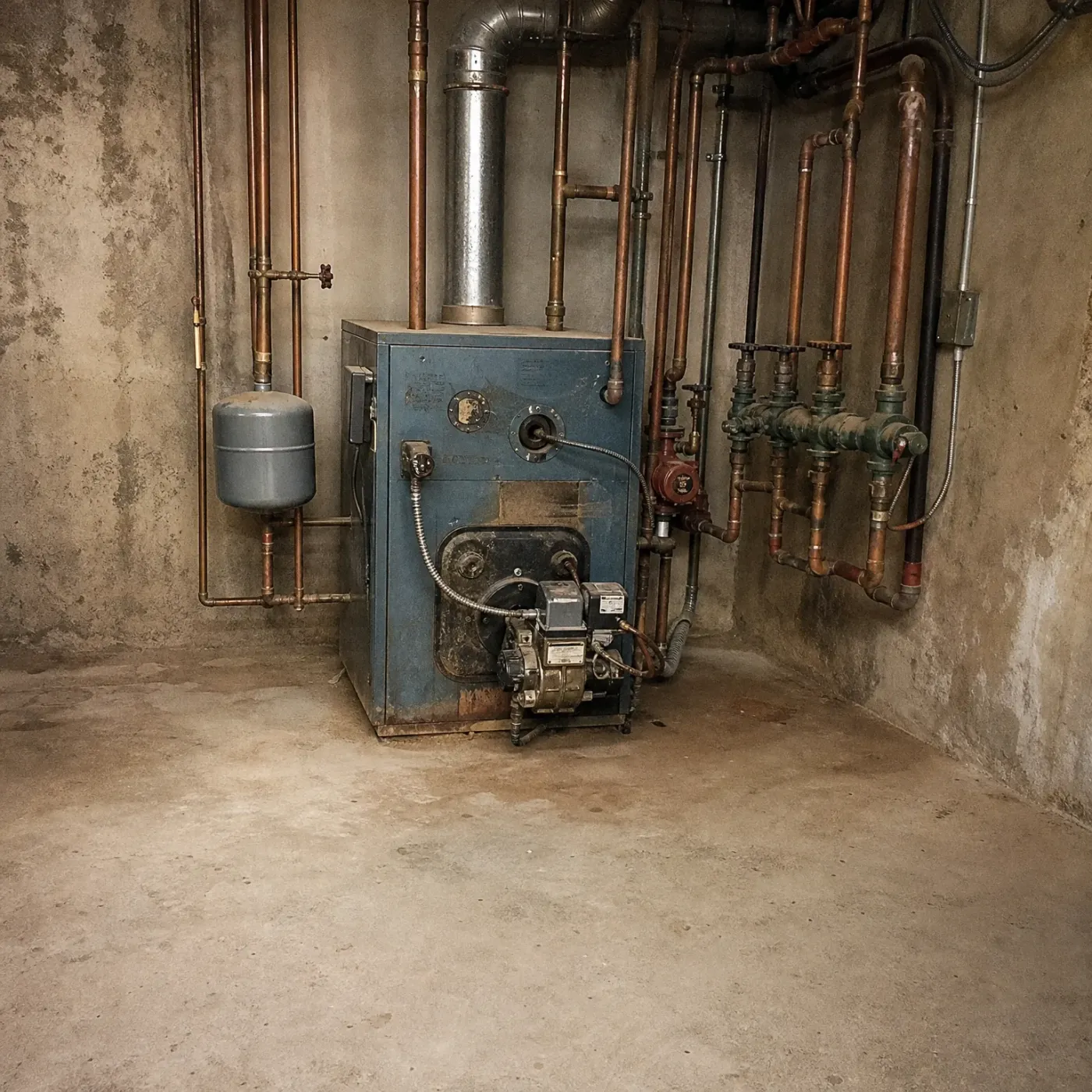
An older blue boiler with a burner unit stands in a concrete basement corner, connected to copper and steel piping, valves and a gray expansion tank on the wall.
Before you get your boiler repair
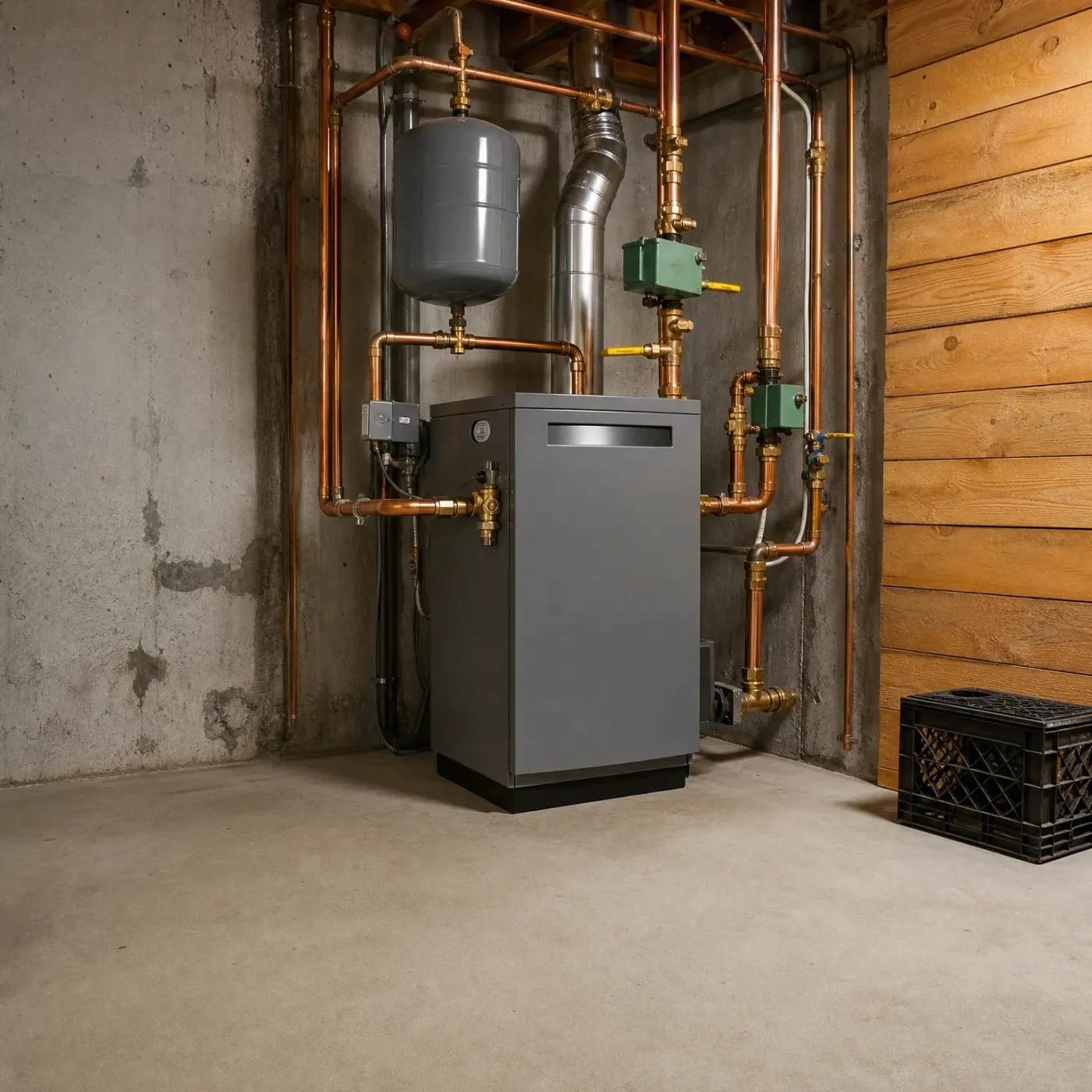
A gray boiler unit in a basement corner with copper piping, brass valves, a gray expansion tank, a metal flue duct, concrete walls and a wood-paneled wall, with a black plastic crate on the floor at right.
After you get your boiler repair

Water takes the easiest path down, so what you see on the floor often traveled from somewhere higher up, along a pipe or down the side of the jacket. That's why a contractor traces the water up before deciding anything needs replacing. Some leaks happen for a reason built into the system. The pressure relief valve is supposed to open once pressure gets too high, so a drip there can mean the valve did its job, even if the valve itself now needs swapping out. Other leaks come from parts wearing out over time. The circulator pump has a seal that lets go slowly, so you might notice a damp spot for weeks before it gets worse. Steel pipe corrodes from the inside, which means a fitting can fail even though the outside looks fine. A cracked cast iron section is the one that won't wait. Once the metal splits from years of heating and cooling, water keeps coming until the section gets replaced. And if the low-water cutoff isn't working right, the boiler can keep firing with too little water in it, which makes every other problem worse.

How a boiler leak actually starts

  • Water finds the lowest point first, so a puddle under the boiler doesn't always mean the leak starts there.
  • The pressure relief valve is designed to open and release water once pressure climbs past its rated limit, usually around 30 psi.
  • A circulator pump has a seal around its shaft, and once that seal wears out, water seeps out slowly rather than all at once.
  • Cast iron sections and heat exchangers can crack from stress after years of heating and cooling, and that crack won't seal itself.
  • Corrosion inside old steel pipes and fittings thins the metal from the inside, so a joint can fail even if it looks fine from outside.
  • A low-water cutoff that's stuck or miswired can let the boiler keep firing with too little water, which stresses the system further.
A woman with shoulder-length brown hair wearing a beige knit cardigan sits in a gray upholstered armchair near a window, looking off to the side with a slight smile, with bookshelves blurred in the background.
A woman with her hair in a bun holds a sleeping young child against her chest, both wrapped in a textured beige knit blanket on a sofa in a dimly lit room with a lamp, framed picture, and bookshelf behind them.

Winter nights average 25°F statewide

Boiler season runs long here. Overnight lows average 25°F across December, January and February statewide, so your boiler is holding pressure and cycling on and off for months straight. A valve or fitting that's marginal won't make it through that stretch without giving out.

NOAA nClimDiv 1991-2020 county normals weighted by homes

A leaking boiler always traces back to one cause, whether that's a tired relief valve, a waterlogged expansion tank, or a fitting that's finally given out after years of pressure and heat. Find that cause and the leak stops. Leave it alone and it gets worse, especially with months of cold still ahead. Boilers aren't as common here as furnaces, and plenty of contractors who handle furnaces and AC units all season rarely touch one. The contractor matched to your repair works on boilers specifically, in Missouri homes like yours, and has likely already seen whatever is going on with yours. You'll hear from one contractor, not a handful of them competing for your callback, so there's no sorting through quotes or explaining the same drip and the same ice-covered window twice. Just someone who already knows what usually fails on these systems, ready to look at yours.

Kitchen corner with cream upper cabinets, oak lower cabinets, white marble-look countertop, beige tile backsplash, a ceramic vase of greenery, a wooden cutting board and bowl, and a black-framed window at right.
Interior corner of a room with a white-framed window and wide sill, beige walls with panel molding, a wooden cabinet holding a ceramic vase with a green leafy plant, and blurred shrubs and trees outside.
A wood-framed armchair with beige cushions and a woven lumbar pillow sits in a corner beside a large window overlooking green trees, with a tall ceramic vase holding leafy branches on the left and plaster walls and wood flooring.
Interior corner with a white-framed window above a sill, beige walls with baseboard molding, a greige shaker-style cabinet with brass knobs and a potted plant on top, light wood flooring and a woven jute rug.
A dark-framed six-pane window with white trim and sill set in gray horizontal lap siding, with hydrangea shrubs below and a white column and shingled roof section at left.

Describe it once

Only one pro gets your request, so you hear from one company.

Find a local pro

You only hire the pro if you want to.